Madrid’s royal palaces, major art collections and lively public squares give Spain’s capital its distinctive character. The country’s largest city stands on the River Manzanares in the central Iberian Peninsula, on the high Castilian plateau. Its history reaches back to a fortified settlement under the Emirate of Córdoba, before its development into the political and cultural centre of Spain.
Today, Madrid combines the ceremonial presence of the monarchy with a cosmopolitan culture of football, performance, food and late-night social life. The galleries around Paseo del Prado are central to its appeal, while parks and busy plazas bring everyday city life into view. Beyond the monuments, annual celebrations and internationally known clubs reveal a capital whose cultural identity extends well beyond its museums.
Top 10 things to do in Madrid
10. Discover Madrid’s annual celebrations
Madrid’s public celebrations bring striking changes to its streets. During La Trashumancia, shepherds exercise their ancient right to drive sheep and other livestock through the city centre. Madrid Pride brings another major annual gathering, extending from late June into early July. These events reveal two distinct strands of the capital’s identity: enduring rural traditions and contemporary international culture.
9. Explore Madrid’s football culture
Real Madrid and Atlético de Madrid give football a prominent place in the city’s cultural life. Both clubs compete in Spain’s top division and regularly appear in European competitions. The Santiago Bernabéu Stadium, associated with Real Madrid, also houses a museum. A visit provides a concrete introduction to a sporting institution whose reach extends far beyond the capital.
8. Walk Gran Vía and see Plaza de Cibeles
Gran Vía presents Madrid at its busiest, with cinemas, shopping and large illuminated signs defining one of the capital’s principal avenues. Plaza de Cibeles adds a more monumental perspective: its neoclassical fountain stands beside the imposing Cibeles Palace. Once the Palace of Communications and now the seat of municipal government, the building gives this central square a distinctive civic presence.
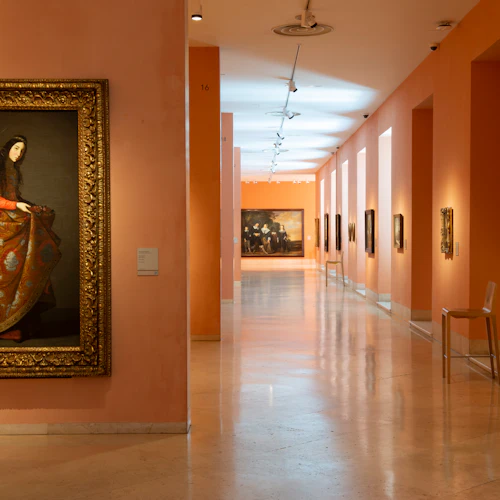
7. Visit the Thyssen-Bornemisza Museum
The Thyssen-Bornemisza Museum completes Madrid’s celebrated trio of major art museums alongside the Prado and Reina Sofía. Rooted in a baron’s collection, its holdings complement those of its neighbours and broaden a visit to the city’s art district. Give the collection its own time: it is a substantial cultural destination within the concentration of galleries around Paseo del Prado.
6. Find Madrid’s meeting point at Puerta del Sol
Puerta del Sol is one of the clearest places to encounter Madrid’s public life. Locals meet here, crowds gather for celebrations and demonstrations, and several familiar city symbols share the square. Look for the Bear and the Strawberry Tree statue, the former Post Office’s clock tower and Kilometre Zero, the reference point for Spain’s road network.
5. See Guernica at the Reina Sofía
Picasso’s Guernica is the defining work to seek out at the Museo Reina Sofía. Madrid’s major museum of modern art gives the city’s artistic story a different focus from the royal collections of the Prado. Its place within the three-museum art district makes it essential to understanding the breadth of the capital’s cultural institutions.
4. Spend time in Retiro Park
Retiro Park provides a spacious green setting within a city known for busy avenues and monumental squares. Madrid’s principal park invites an unhurried walk or a pause from the museums and streets. The monument to Alfonso XII is one of its gathering points, with drum circles adding a social rhythm to summer evenings around the statue.
3. Take in Plaza Mayor
Plaza Mayor is among Madrid’s best-known landmarks and a defining expression of its grand public spaces. Spend time taking in the square as a whole, then watch how visitors and everyday city life share it. Its strong architectural presence makes it a natural place to appreciate the ceremonial scale that royal history brought to the capital.
The Royal Palace of Madrid gives monumental form to the capital’s royal identity. One of Europe’s largest palaces, it remains the Spanish monarch’s official residence, although the royal family lives elsewhere and the building is generally used for state ceremonies. Its enormous scale makes the monarchy’s historic influence on Madrid immediately tangible.
The Prado Museum is Madrid’s defining art destination, with collections rooted in the holdings of the Spanish monarchy. Goya’s celebrated works are a particular draw, within a museum whose depth makes it central to the city’s international cultural standing. Give individual paintings sustained attention: the collection rewards close looking as much as an appreciation of its extraordinary breadth.
 All experiences


 Madrid
 (1692)
 Buy Ticket
 More information








 138