All experiences


 València
Valencia: Small-Group Guided E-bike Tour
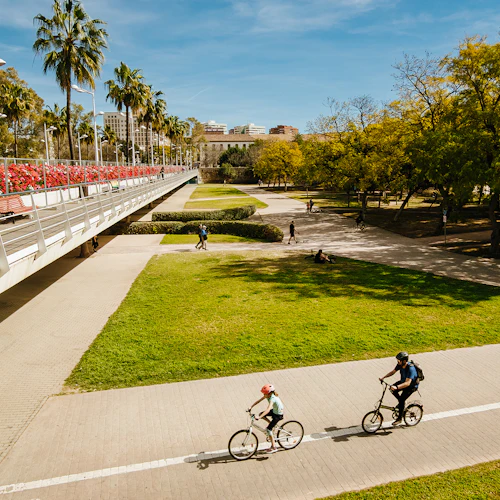
Visit Plaza de Toros and enjoy a ride through Jardín del Túria


 València
 combines a remarkable Gothic heritage with the striking modern architecture of the City of Arts and Sciences. On Spain’s Mediterranean coast, the capital of the Valencian Community is the country’s third-largest city. Its identity stretches from a Roman foundation through Islamic rule and its emergence as a Christian kingdom to the trading prosperity that shaped its most celebrated medieval monuments.
The city’s appeal extends well beyond its buildings. The former Turia riverbed has become a major park, beaches connect it to the Mediterranean, and paella anchors its culinary reputation. Falles, the annual celebration of sculpture, satire and fire, remains one of its defining cultural traditions. Together, these places and customs give València a distinctive rhythm across its historic centre, green spaces and seafront.
València’s beaches bring the Mediterranean into a visit otherwise rich in monuments and museums. Leave time for the shore alongside the historic centre: the open coastal setting is an important part of the city’s geographical character. A beach visit adds a straightforward outdoor counterpoint to exploring Gothic halls, church interiors and contemporary architecture.
Paella is central to València’s culinary reputation and deserves a place alongside its architectural landmarks. Make a meal of this celebrated rice dish part of exploring the city’s culture. Food is one of the clearest connections between everyday life and the visitor experience here, giving the destination an identity that extends beyond its monuments.
The archaeological crypt of the prison of Sant Vicent Màrtir brings several layers of the city’s past into one compact visit. Its Visigothic chapel contains finds including an altar, a Roman mural and Muslim artefacts. A sculpture represents the early Christian saint believed to have been buried here, connecting the excavated objects with the site’s religious associations.
The Torres dels Serrans are among the prominent monuments associated with València’s medieval golden age. Their imposing architecture makes them an important stop when exploring the city’s historic fabric. They also remain connected to living traditions: the Cridà, the ceremonial call announcing the Falles season, gathers crowds around the towers and the Turia riverbed.
The Church of San Nicolás pairs a Gothic structure with an extensively decorated Baroque interior. Frescoes cover the vault of the nave and the presbytery, illustrating the lives of Saint Nicholas and Saint Peter. Designed by Antonio Palomino and painted by Dionis Vidal, the restored paintings make the ceiling the focus of a visit.
The Turia Gardens occupy the river’s former course, transforming a major piece of infrastructure into one of València’s defining public spaces. After catastrophic flooding in 1957, the river was diverted south of the city; its abandoned bed later became a park. Walking here reveals a different scale of València, with green space following the route once taken by water.
València’s cathedral brings together Gothic architecture and elements from successive periods of rebuilding. Look for the Gothic Puerta de los Apóstoles and the older Romanesque Puerta del Palau, which shows Moorish influences. The Micalet bell tower is a landmark of the city’s medieval heritage, while the Chapel of the Holy Chalice holds an agate cup traditionally associated with the Holy Grail.
Designed by Santiago Calatrava and Félix Candela, the City of Arts and Sciences gives València its most recognisable modern architectural ensemble. Explore its sculptural exterior spaces, then delve into the interactive exhibits at the Science Museum, whose building resembles a whale skeleton. The Oceanogràfic adds marine habitats arranged by ecological zone and Candela’s distinctive water-lily-shaped architecture.
The UNESCO-listed Llotja de la Seda is the outstanding architectural expression of València’s mercantile prosperity. Built between 1482 and 1533, this secular Gothic complex rewards close attention to its individual spaces: the columned Trading Hall, the richly ceilinged Sea Consulate hall and the Patio of Oranges. Its sculpted gargoyles add irreverent detail to a building shaped by the serious business of trade.
Falles is València’s defining annual celebration, filling March with monumental satirical sculptures, fireworks and the forceful percussion of gunpowder displays known as mascletàs. Neighbourhood associations work throughout the year to create the figures and elaborate compositions that culminate in public burnings. Recognised by UNESCO as intangible cultural heritage, the festival unites craft, collective effort and spectacle on the city’s streets.
 Buy Ticket
 More information