 All experiences


Best History in New York

Must-See Venues in New York
See more venues
All attractions in New York
 New York


Top 10 Things to Do in New York: Landmarks, Art & Culture
The Statue of Liberty, the Manhattan skyline and Broadway’s theaters give New York an instantly recognizable identity. At the southern tip of New York State, beside New York Harbor and the mouth of the Hudson River, the United States’ most populous city encompasses five boroughs: Manhattan, Brooklyn, Queens, the Bronx and Staten Island. Its harbor has long connected the city to the wider world, while immigration has profoundly shaped its cultural life.
Lenape history precedes the Dutch settlement that became New Amsterdam and later passed into English control. Today, New York combines international finance and diplomacy with influential art museums, theater, music, film and fashion. Its defining visitor experiences range from monumental landmarks to public parks and exuberant street celebrations.
Top 10 things to do in New York
10. Visit the 9/11 Memorial & Museum
The 9/11 Memorial & Museum brings remembrance and historical reflection into a New York visit. Its paired roles as memorial and museum make it a place both to pause and to engage with the events it commemorates. Give this visit focused attention, with room for reflection alongside the city’s more celebratory cultural landmarks.
9. Discover New York’s parade traditions
Macy’s Thanksgiving Day Parade and the Village Halloween Parade are defining expressions of New York’s public celebrations. The Halloween procession brings costumes and street performance to Sixth Avenue, while the Thanksgiving parade anchors another major annual tradition. These events reveal a participatory side of the city, with streets becoming settings for spectacle and collective celebration.
8. Hear music and discover film at Lincoln Center
Lincoln Center gathers several of New York’s major performing-arts institutions on the Upper West Side, including the Metropolitan Opera, New York City Ballet and New York Philharmonic. A performance connects visitors directly with the city’s musical and theatrical life. Film also has a strong presence here through repertory screenings, experimental work and the New York Film Festival.
7. Explore Wall Street and Federal Hall
Wall Street places New York’s financial influence beside important chapters of American political history. Federal Hall marks the location where the first United States Congress convened and George Washington was inaugurated as president. Exploring these landmarks together gives the Financial District historical depth, connecting the institutions of the early republic with the city’s continuing role in global finance.
6. Visit the Museum of Modern Art
The Museum of Modern Art, commonly known as MoMA, is a major stop for art in Midtown Manhattan. Its cultural reach also extends to cinema, with repertory screenings forming part of its program. A visit brings New York’s visual-art and film cultures into the same itinerary, within one of its best-known museum institutions.
5. See Broadway and Times Square
Times Square’s illuminated signs form the backdrop to New York’s Theater District, where Broadway’s major musicals and dramatic productions take the stage. Seeing a performance is central to understanding the city’s entertainment culture. Beyond Broadway, smaller Off-Broadway and Off-Off-Broadway productions extend that theatrical life across Manhattan, adding more intimate settings to an exceptionally varied performance scene.
4. Explore the Metropolitan Museum of Art
The Metropolitan Museum of Art is one of New York’s defining museum destinations and an essential stop in a city renowned for its cultural institutions. Give the visit a substantial place in the day, allowing time to engage with the art. The Met also provides a valuable counterpoint to an itinerary dominated by skyline views and street-level landmarks.
3. Spend time in Central Park
Central Park brings a naturalistic landscape into the heart of New York’s urban identity. Walking through the park changes the pace of a visit and gives space to appreciate a city whose appeal extends well beyond buildings and museums. Its greenery and open-air setting are as integral to New York’s familiar image as the surrounding skyline.
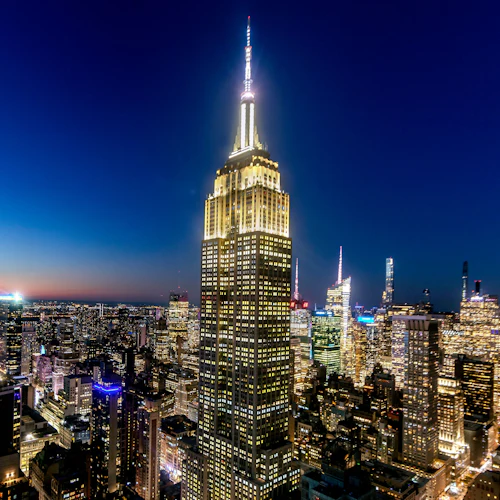
2. Take in the skyline from the Empire State Building
The Empire State Building is a defining feature of Manhattan’s skyline and one of New York’s most recognizable landmarks. Its 86th-floor observation deck turns the city itself into the focus of the visit. Looking out across the buildings gives a sense of the scale and concentration that make New York’s urban landscape so distinctive.
1. Visit the Statue of Liberty and Ellis Island
The Statue of Liberty stands in New York Harbor as a symbol of the United States and the city’s most emblematic landmark. Nearby Ellis Island preserves the place where millions of immigrants completed their journey to America. Visiting them together connects an internationally recognized monument with the human history that helped shape New York’s cosmopolitan character.